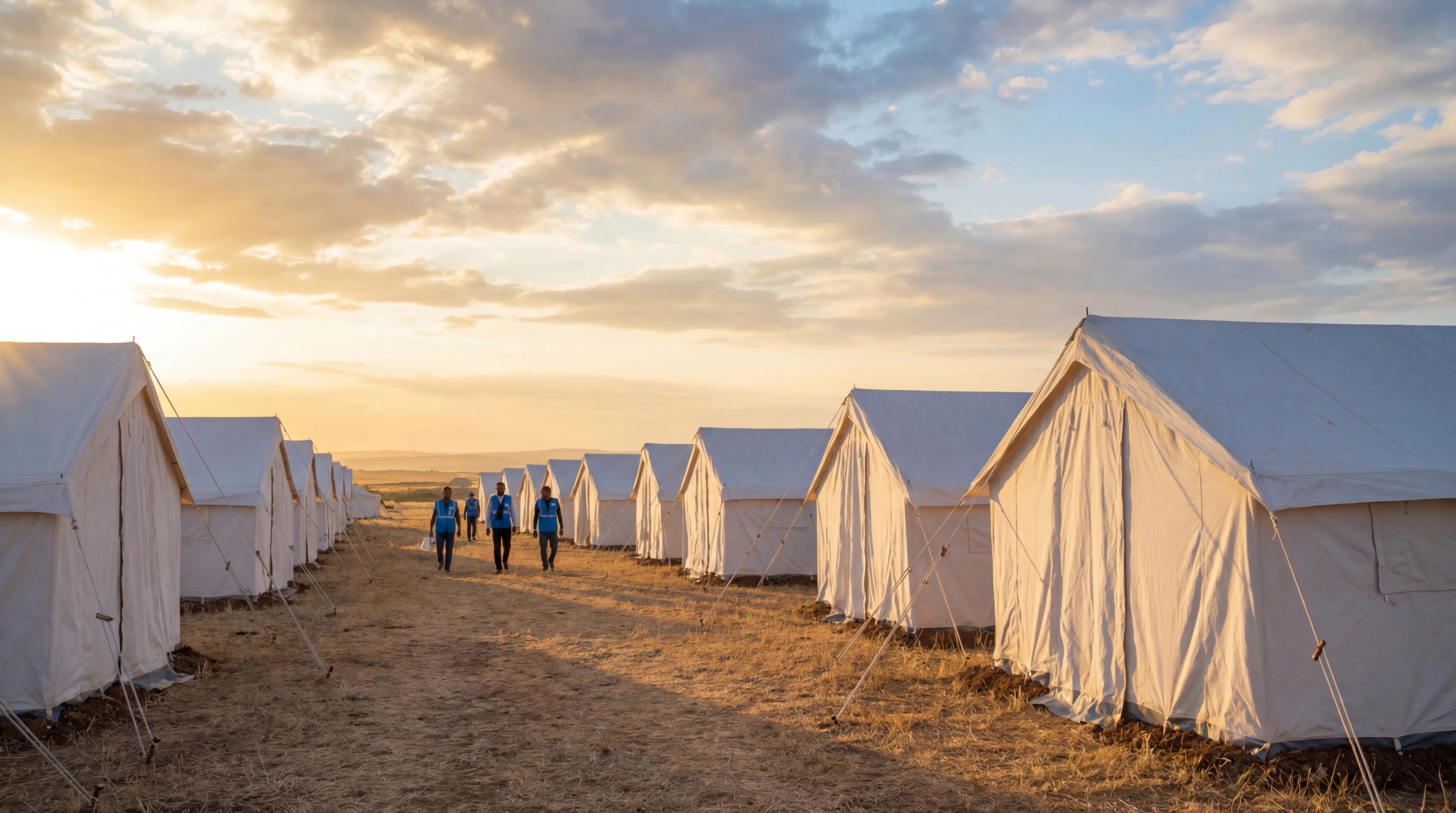
Emergency shelter for displaced families. Waterproof cotton canvas, built to last 12+ months in camp conditions. We manufacture to UNHCR and IFRC standards and keep stock ready for immediate dispatch.
Or call +92 300 823 9990 — available 24/7 for emergencies
Trusted by
A refugee tent is not a camping tent. That distinction matters more than most people realize. A camping tent is designed to be used for a few days or weeks by someone who chose to be outdoors. A refugee tent is designed to be used for months — sometimes years — by a family that had no choice in the matter. Everything about how these tents are built reflects that difference.
Refugee tents use heavyweight cotton canvas, typically 350-380 GSM, instead of the thin polyester or nylon found in consumer tents. The canvas is treated for waterproofing, rot resistance, fungus resistance, and UV protection because it will sit in direct weather around the clock with no breaks. The frames are galvanized steel, not fiberglass or aluminum — heavier, yes, but far more durable when a tent needs to survive storms and daily use for a year straight.
The floor area matters too. UNHCR specifications require at least 3.5 square meters per person. A family tent at 4m x 6m gives a family of five about 24 square meters — space to sleep, store belongings, and have some basic privacy. That might sound generous until you consider that this tent is someone's entire home. It is where they sleep, eat, study, and try to maintain some sense of normal life.
BNC has been manufacturing refugee tents since 1994. We supply them to UNHCR, UNICEF, ICRC, OXFAM, and dozens of other organizations that operate camps across the Middle East, Africa, South Asia, and beyond. We know what these tents go through in the field because we hear directly from the agencies that use them.
Each model is purpose-built for camp environments. All use cotton canvas and meet international humanitarian standards.
The standard shelter for displaced families. Ridge pole A-frame design, accommodates 5-6 people. This is the tent used in most refugee camp deployments worldwide. Two people can set it up in under 30 minutes.
Double-layer canvas with quilted thermal inner lining. Effective down to -20C. Includes stove jack for heating and adjustable snow-flap ventilation. Deployed in camps in Afghanistan, northern Pakistan, Nepal, and Central Asia.
Built to exact UNHCR specifications. Center pole, single fly design. This is what agencies order when they need certified, proven shelter that will pass procurement inspection.
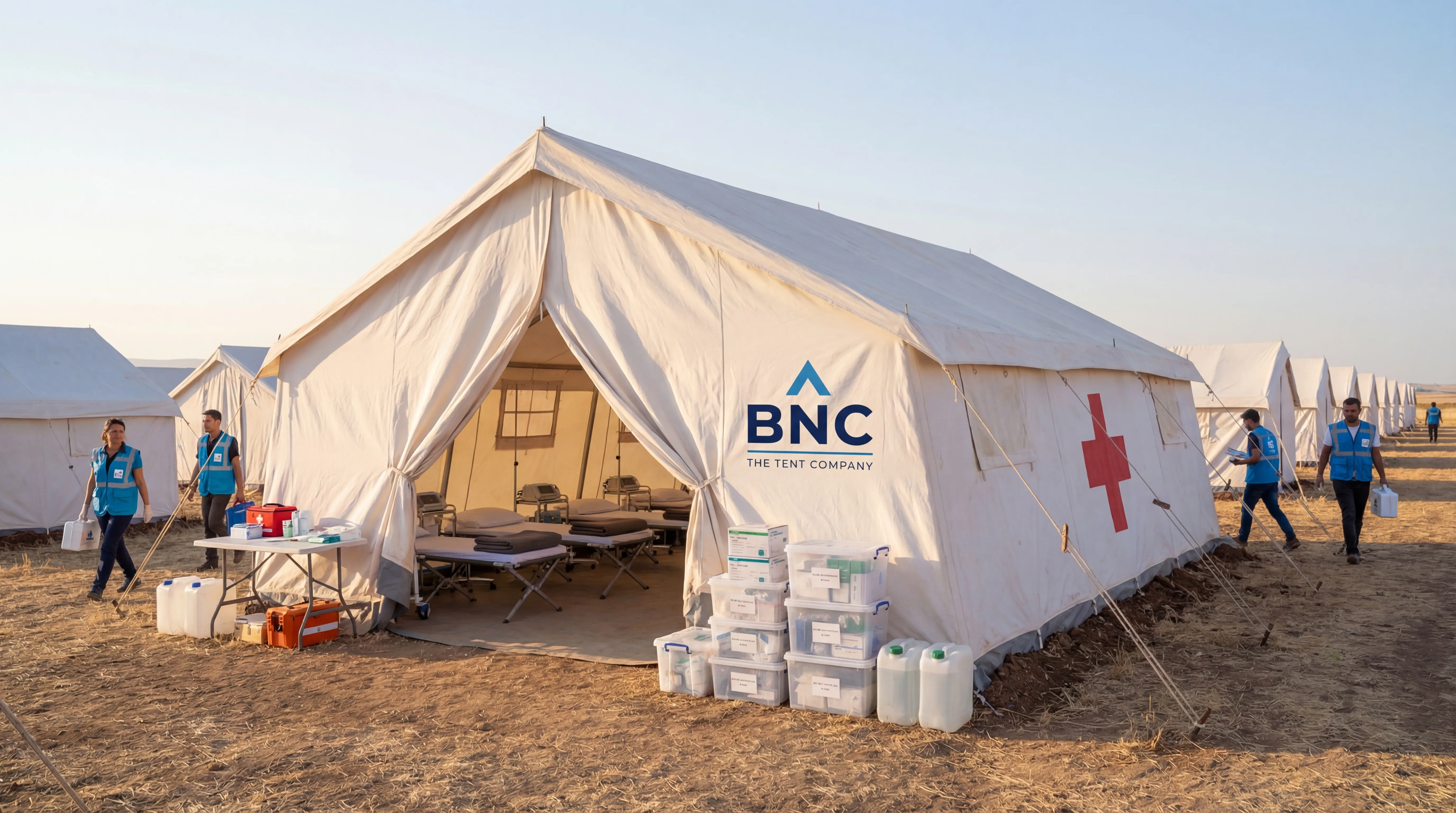
Large-format tent for medical clinics, schools, distribution points, and community gathering spaces within refugee camps. Modular design allows units to be linked end-to-end for expanded coverage.
Lightweight version designed for the first hours and days of a displacement crisis. Packs compact enough for airlift pallets. Gets families under shelter fast while larger camps are being set up.
Privacy enclosure for latrines and showers. Opaque walls, zippered door, upper ventilation for airflow, open bottom for drainage. Dignity matters in a camp, and this is one small way to provide it.
Full spec sheet for all refugee tent models. Custom sizes and configurations available through our custom manufacturing service.
| Model | Size | Canvas | Capacity | Weight | Standard |
|---|---|---|---|---|---|
| Family Tent | 4m x 6m x 2.8m | 380 GSM Cotton | 5-6 persons | ~85 kg | UNHCR/IFRC |
| Winterized Tent | 4m x 6m x 2.8m | Double 380 GSM + Thermal | 5-6 persons | ~110 kg | UNHCR Winter |
| UNHCR Relief Tent | 4m x 4m x 2.7m | 380 GSM Cotton | 4-5 persons | ~65 kg | UNHCR/ICRC |
| Community Tent | 6m x 12m x 3m | 350 GSM / PVC | 20-30 persons | ~200 kg | Mass Shelter |
| Emergency Tent | 3m x 4m x 2.5m | 350 GSM Cotton | 3-4 persons | ~45 kg | Rapid Deploy |
| Privacy Tent | 1.2m x 1.2m x 2.2m | 280 GSM Cotton | 1 person | ~15 kg | Sanitation |
All models include poles, pegs, guy-ropes, and repair kit. PE ground sheets available separately.
You will find both cotton canvas and synthetic (polyester, nylon) refugee tents on the market. They are not interchangeable, and the choice of material has real consequences for the families living in them.
Cotton canvas breathes. In a hot climate — and most refugee camps are in hot climates — a canvas tent allows air to move through the fabric, reducing interior temperature. A polyester tent in direct sun becomes an oven. People inside suffer heat stress, children get dehydrated, and the tent becomes uninhabitable during the hottest hours of the day. UNHCR figured this out decades ago, which is why their specifications require cotton canvas.
Canvas also insulates better in cold weather. In winter camps in Afghanistan, Pakistan's northern areas, or Central Asian countries, the thermal mass of heavy canvas provides measurably better heat retention than thin synthetics. Our winterized refugee tents add a quilted thermal inner layer to double-wall canvas, creating an air gap that works like insulation in a house.
There are trade-offs. Canvas is heavier than polyester — a family tent weighs around 85 kg versus 30-40 kg for a synthetic equivalent. It costs more per unit. And it requires chemical treatment for waterproofing and rot resistance, while polyester is naturally water-resistant. But in the context of a tent that needs to be someone's home for a year or more, the performance advantages of canvas outweigh the weight and cost penalty.
Cotton canvas also does not produce toxic fumes when it burns. In a camp with thousands of tents where cooking fires and kerosene lamps are common, fire safety is not a theoretical concern. Polyester melts and releases poisonous gases. Canvas chars but does not melt, and when treated with fire retardant, it self-extinguishes.
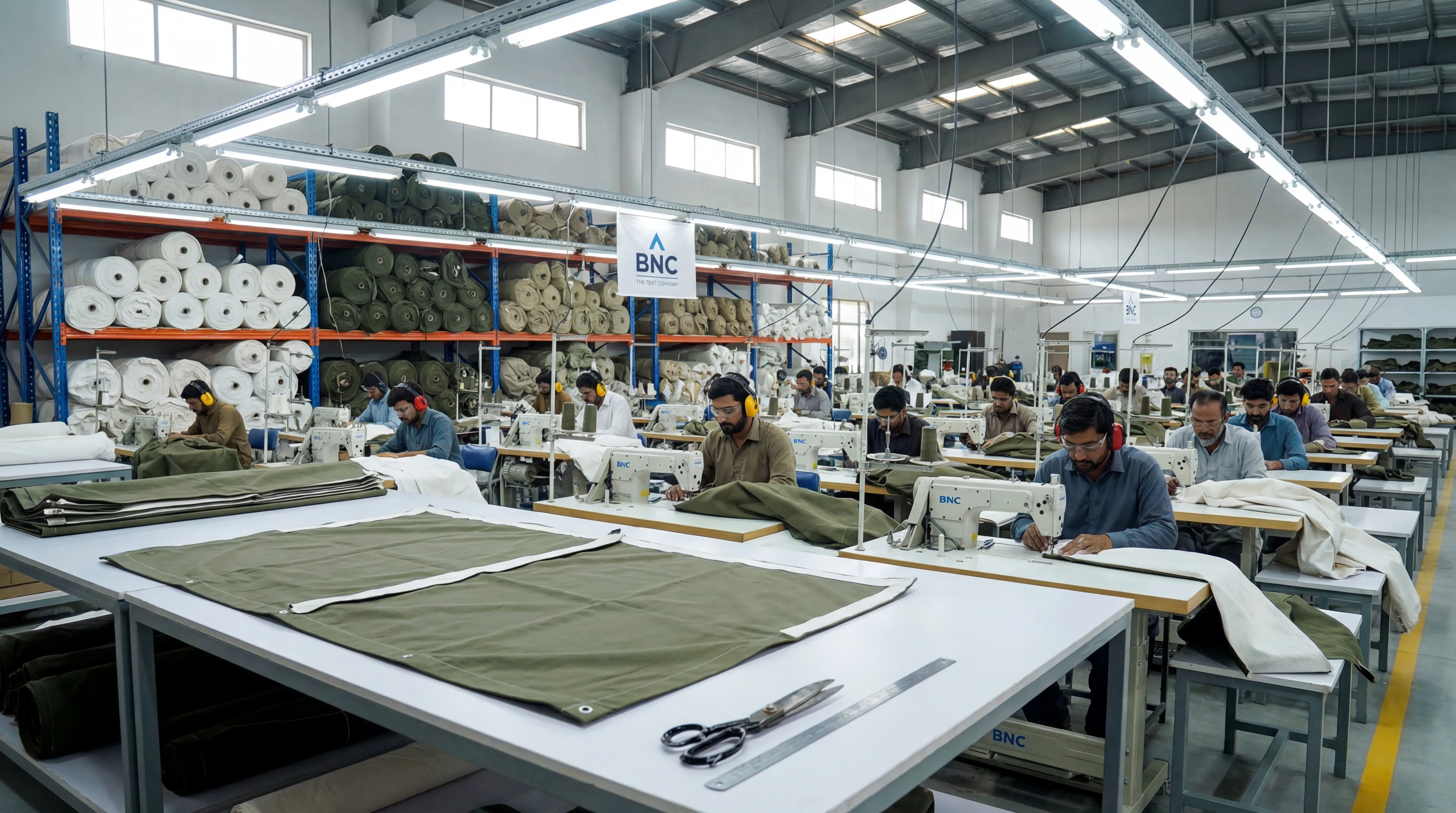
BNC manufactures all our refugee tents in cotton canvas. We use 380 GSM fabric — slightly above the UNHCR minimum of 350 GSM — because the extra weight adds durability without meaningfully increasing cost. The fabric is treated in-house for waterproofing, rot resistance, fungus resistance, and UV protection. We do not outsource treatment because controlling this step is how we ensure consistent quality.
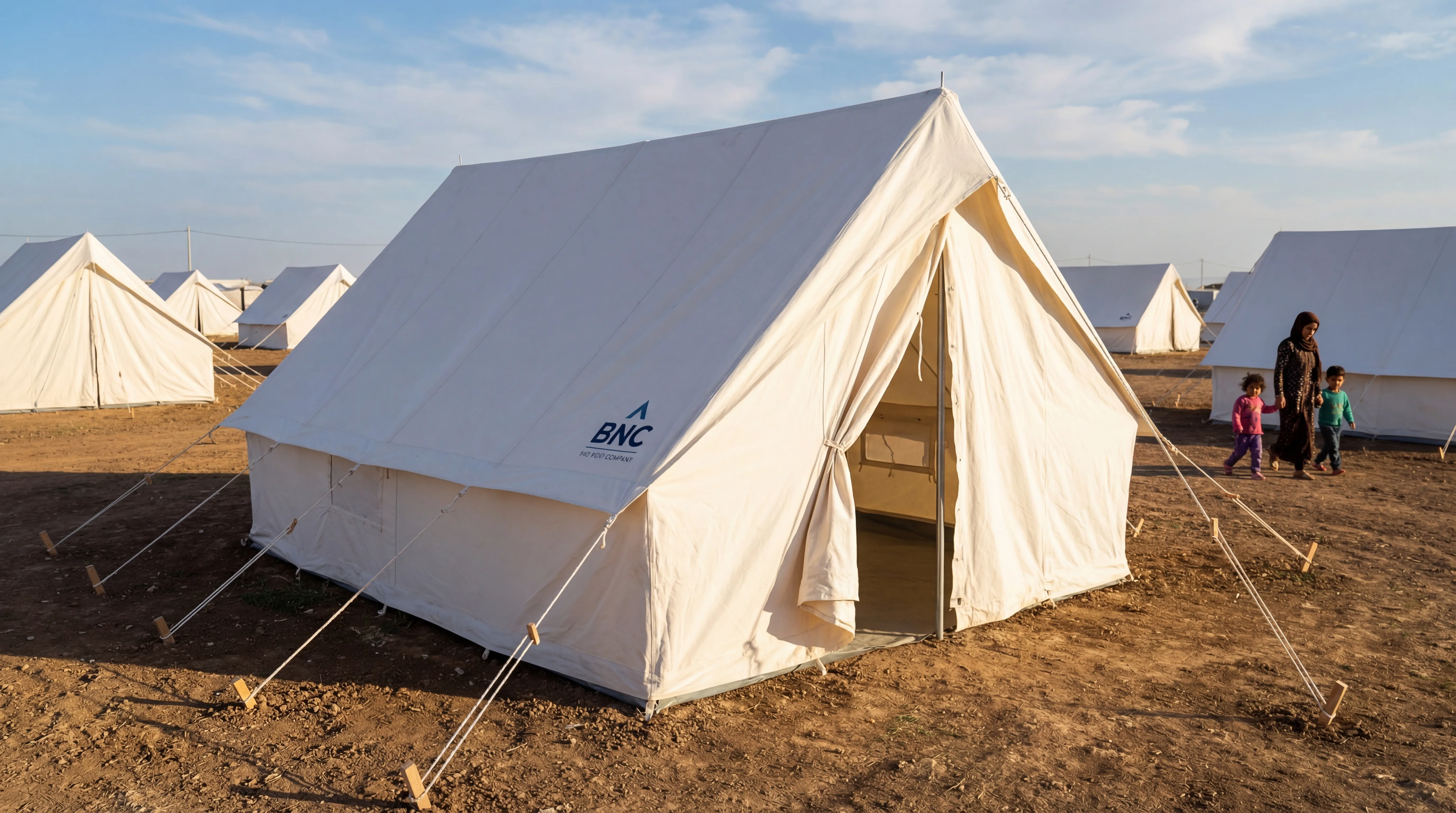
Refugee tents go wherever people are forced from their homes. That happens more often than most of the world pays attention to. Conflicts, earthquakes, floods, droughts — the triggers vary but the need is the same: families need shelter, and they need it fast.
BNC has supplied refugee camp tents to operations across the Middle East (Syria, Iraq, Yemen), East Africa (Somalia, South Sudan, Ethiopia), South Asia (Pakistan, Afghanistan, Bangladesh), and Southeast Asia (Myanmar displacement). Each region presents different challenges — extreme heat in the Middle East, monsoon rains in South Asia, cold winters at altitude in Afghanistan — and the tent has to handle them all.
Camp sizes range from a few hundred tents for localized displacement to tens of thousands of tents for large-scale crises. The logistics of supplying those camps are complicated. Tents need to be manufactured, packed, shipped, received, distributed, and erected — often in areas with limited infrastructure, poor road access, and active security concerns. This is why ready stock matters. When an agency orders 5,000 refugee tents, they do not have time to wait for a 4-week production cycle. BNC maintains warehouse stock of the most commonly ordered models precisely for this reason.
Our facility near Karachi's international airport and seaport means we can ship to most destinations via either air or sea. For emergencies, air freight from Karachi reaches most of the Middle East and East Africa within 24-72 hours. For planned pre-positioning orders, sea freight is more cost-effective.
Rain, wind, sun, cold, heat. The tent is the barrier between a family and the elements. If it leaks, if it collapses in wind, if it traps heat — it fails at its most basic job. Every material and construction choice in our tents starts from this requirement.
A family of five or six needs room to sleep, store belongings, and have basic daily life. The standard 4m x 6m tent provides 24 square meters. That is not generous, but it is livable. The 3.5 sqm per person UNHCR minimum is based on years of camp management experience.
Refugee situations are rarely short-term. Families live in tents for months, sometimes years. The tent needs to survive daily use, weather cycles, UV exposure, and the wear of being a home. That is why we use 380 GSM canvas and galvanized steel frames — heavier, but built to last.
In the chaos of a displacement crisis, tents are often set up by the families themselves, not trained crews. Our tents are designed so two adults can erect them in under 30 minutes using basic tools. Clear instructions are included in every kit.
Living in a camp means losing almost everything. A tent that provides real privacy — opaque walls, secure door closures, and enough space to have some personal area — gives families back a small piece of normalcy. It matters more than specifications can measure.
Ventilation panels for hot weather. Stove jacks for cold weather. Roll-up walls for airflow. Zip-down closures for rain. Refugee tents need to work across seasons because families cannot swap shelters when the weather changes. Our designs account for this.
Whether you need immediate emergency stock or a planned procurement for pre-positioning, we have the inventory and manufacturing capacity. Tell us what you need and we will respond within 24 hours.
Request a Quoteor call +92 300 823 9990 (24/7 emergency line)